
A private label bra manufacturer allows a lingerie business to sell bras under its own brand while outsourcing product manufacturing. Private label can range from relatively simple branding of an existing construction to significant customization of fabrics, colors, trims and fit.
The key is understanding how much customization your project actually requires. A private-label program is most efficient when the product, branding and commercial requirements are defined before bulk materials are ordered.
What Private Label Means in Bra Manufacturing
In a private-label arrangement, the finished product carries the buyer’s brand identity. Depending on the project, this may include woven labels, printed care labels, hangtags, retail packaging and customized colors or fabrics.
The underlying bra can be based on an existing factory style or developed more extensively.
Start by Choosing the Right Product
Branding should not be the first decision. Before adding labels, confirm that the bra meets the intended customer requirements for cup shape, support, coverage, comfort and size range.
If the base product is not right, additional packaging will not improve customer satisfaction.
Existing Style or Custom Development?
Using an existing construction may reduce development time because the basic pattern and sewing method are already proven. Full customization provides more differentiation but normally requires more sampling.
Brands should decide where they need uniqueness: silhouette, cup, material, lace, color, support level, branding or packaging.
Private Label Fabric Choices
Changing fabric can significantly change the feel and behavior of the bra. Stretch, recovery and thickness should be considered before approving a replacement.
For further material information, see Bra Factory China | OEM & Private Label Bra Manufacturer.
Labels Need Technical Planning
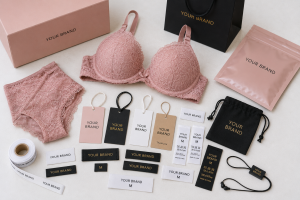
Woven labels, heat-transfer labels and printed care labels each have different applications. Label placement should avoid irritating the wearer and should remain readable after normal use.
Buyers also need to confirm what regulatory and fiber-information requirements apply in their destination markets.
Hangtags and Retail Presentation
Hangtags communicate brand positioning, product information and often barcode or SKU details. They should be designed early enough to avoid delaying packing, but only after the product specification is stable.
Packaging Is Part of the Purchase Order
Packaging can include individual polybags, recycled bags, boxes, tissue, stickers, barcodes and master cartons. These details affect cost and production preparation.
Brands supplying ecommerce warehouses should also confirm carton marks and barcode requirements in advance.
Why Sampling Still Matters
Even when the base construction already exists, changing fabric, elastic or trims can influence performance. A private-label sample allows the buyer to confirm both product quality and branding before production.
Related sampling issues are discussed in Bra Set Manufacturer: OEM & Private Label Production Guide.
MOQ Is Not Always Controlled by the Sewing Factory
Minimums can come from custom fabric, dyed elastic, lace, packaging or hardware suppliers. This is why splitting a small order across many colors can sometimes be difficult.
A practical first collection often uses a focused number of styles and colors rather than trying to launch every possible variation.
Understand What Is Included in the Price
Ask whether the quotation includes labels, hangtags, special packaging, custom trims and other branding elements. Two factories may quote different prices because their assumptions are different.
For broader cost considerations, see High Quality Bra Manufacturer | OEM & Private Label Lingerie Manufacturing.
Quality Control Protects Your Brand
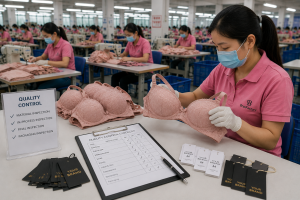
Private-label products carry your name, so the finished order should be checked against approved measurements, materials, workmanship and branding.
Inspection should include stitching, symmetry, elastic attachment, hardware, labels, stains, packing and quantity.
How to Compare Private Label Manufacturers
Relevant lingerie experience matters more than a generic garment capability. Ask what categories the factory regularly produces, whether it supports fitting revisions and how it controls materials and bulk production.
Additional supplier-selection perspectives are available in How to Find a Reliable Private Label Bra Manufacturer | Complete OEM Guide and Private Label Bra Cost Guide: Complete Pricing Breakdown for Brands.
Information to Send When Requesting a Private Label Quote
- target style or reference product;
- planned size range;
- materials or visual direction;
- color quantity;
- estimated units;
- label artwork;
- packaging instructions;
- destination market;
- target schedule.
Private Label Production at BrasFactory
BrasFactory supports overseas brands with private-label and OEM bra manufacturing from Puning, Guangdong. Projects can range from adapted existing constructions to more customized developments.
A clear specification helps determine which approach is most efficient for the brand.
For another related BrasFactory resource, see Private Label Bra Manufacturer: Build Your Brand with OEM Lingerie Production.
Frequently Asked Questions
Is private label the same as OEM?
The terms overlap. Private label emphasizes the buyer’s branding, while OEM often emphasizes manufacturing to the buyer’s product specification.
Can I add my own logo and packaging?
Yes, subject to the agreed project specifications, quantities and artwork requirements.
Do I need to sample an existing factory style?
Sampling is still recommended when materials, colors, labels or other important elements have changed.
Private Label Does Not Mean Every Product Must Be Identical to a Factory Stock Style
Some buyers assume private label means purchasing a completely fixed product and only adding a logo. In practice, many private-label projects allow a controlled level of customization.
A brand may start with a proven base construction and then modify the lace, outer fabric, color, strap width, label placement or packaging. This can provide a useful balance between product differentiation and development efficiency.
How to Plan a First Private Label Collection
For a new brand, a focused assortment is often easier to manage than a very large launch. Instead of ordering many styles in many colors, it can be more practical to begin with a smaller number of products that clearly represent the brand’s positioning.
This makes sample approval, material purchasing, size planning and quality control easier to coordinate. The lessons from the first order can then guide future collection expansion.
Why Size Breakdown Matters for MOQ
A total order quantity alone does not tell the complete story. The buyer also needs to decide how units are divided by size and color. If a small total quantity is split across many combinations, some combinations may become inefficient to produce or difficult to support with material minimums.
A realistic size curve based on the target customer can help simplify the first order.
Label and Packaging Artwork Should Be Final Before Production
Incorrect or late branding artwork can delay production even when the bras themselves are ready. Buyers should check spelling, sizing information, care instructions, barcode data and packaging dimensions before approving artwork.
When several label types are used, each one should have a clearly identified placement and specification.
Reordering Becomes Easier When the First Order Is Documented Well
A well-managed private-label project creates records that support repeat orders. Approved materials, color standards, label artwork, packaging instructions and product specifications can all be referenced again.
This reduces the need to reconstruct decisions from old emails and helps both the buyer and manufacturer maintain consistency.
Private Label Is a Brand-Building Tool, Not Only a Manufacturing Shortcut
The strongest private-label programs still require thoughtful product selection and quality control. The goal is not simply to place a logo on a generic product. The goal is to create a consistent product experience that customers associate with the brand.