
Finding the right bra manufacturer China sourcing partner involves more than requesting three quotations and selecting the lowest number. Bras are technically demanding products, and a supplier’s experience in cup construction, stretch materials, elastics and fitting can have a direct effect on the quality of the finished collection.
China has a mature lingerie supply chain, but factories differ significantly in specialization, development capability and quality-management practices. Buyers should evaluate these factors before committing to bulk production.
Why China Remains Important for Bra Manufacturing
China’s lingerie supply chain includes fabric mills, lace suppliers, elastic producers, cup suppliers, wire manufacturers, hardware companies and packaging vendors. This network can support a wide variety of bra categories and customization requirements.
However, supply-chain depth does not mean every factory is appropriate for every product.
Look for Lingerie Specialization
A general garment factory may be able to sew simple clothing but still lack experience with bra fit and construction. Specialist bra manufacturing involves understanding cup volume, wire shape, wing recovery, elastic tension and multiple small components.
Before choosing a supplier, ask which bra categories are produced regularly.
Evaluate the Sample-Development Process
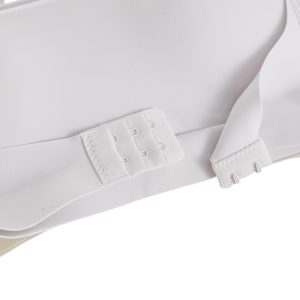
A capable factory should be able to explain how it turns a reference sample or Tech Pack into a development sample, how revisions are recorded and how the final specification is approved.
If the factory treats sampling as an informal trial rather than a controlled technical process, bulk consistency may be harder to manage.
Related development lessons are available in How to Evaluate Bra Factory Production Capacity Before Ordering.
Ask How Materials Are Controlled
A quotation should not simply state “nylon fabric” or “lace.” Different materials with the same generic description can have different weight, recovery, softness and durability.
Buyers should know which material is being quoted, whether substitutions require approval and how color variation is managed.
Understand Supplier MOQ
Factory MOQ and material MOQ are not always the same. A sewing factory may accept a certain quantity while the lace, elastic or fabric supplier requires a larger purchase.
This distinction becomes important when an order is divided across several colors.
Compare Like With Like When Reviewing Price
A lower quotation may use cheaper materials, simpler construction or different packaging assumptions. Buyers should compare factories only after the technical specification is aligned.
For related cost discussions, see Bra Factory Audit Checklist: What Brands Should Inspect Before Ordering.
Communication Quality Is a Manufacturing Issue
Fast replies are helpful, but accurate technical communication matters more. A good supplier confirms changes in writing, raises questions when the specification is unclear and keeps a record of approved decisions.
Agreeing to every request immediately is not always a positive sign. Experienced manufacturers may challenge details that could create production problems.
Review the Factory’s Quality-Control Method
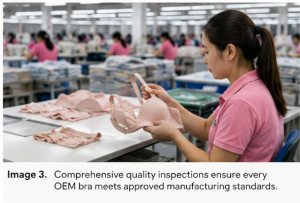
Quality should be checked during manufacturing, not only at final packing. Measurements, cup symmetry, stitching, elastic, wire insertion, hardware, labels and cleanliness are typical inspection areas.
Buyers should define the approval standard before production rather than after defects are discovered.
Evaluate Capacity According to Your Product
A large factory is not automatically the best fit for every brand. Smaller development-heavy orders and high-volume repeat orders place different demands on production management.
Ask how the supplier schedules samples, production lines and repeat orders.
Assess Private-Label Capability
If products will carry your brand, verify that labels, hangtags, packaging and barcode requirements can be managed accurately.
Additional private-label considerations can be found in Bra Factory China | OEM & Private Label Bra Manufacturer.
Red Flags During Supplier Evaluation
- a firm final price before sufficient specifications are provided;
- no clear sample revision process;
- unwillingness to explain material specifications;
- poor version control;
- no explanation of bulk quality checks;
- frequent undocumented substitutions.
Factory Location Matters Less Than Factory Capability
Different manufacturing regions have different supply-chain strengths. BrasFactory’s factory is located in Puning, Guangdong, with access to the broader Guangdong apparel and lingerie supply ecosystem.
Buyers should still evaluate the actual factory rather than assuming every supplier in the same region offers equivalent capability.
Questions to Ask Before Ordering
- What bra categories do you specialize in?
- Can you develop from a physical reference sample?
- How are fitting revisions documented?
- How are materials approved?
- What causes your MOQ?
- How is bulk quality inspected?
- Can you manage branded labels and packaging?
For additional supplier and manufacturing perspectives, see How to Evaluate a Bra Manufacturer Before Starting OEM Production, Seamless Bra Manufacturer | OEM & Private Label Bra Factory in China and Bra Factory Audit Checklist: 15 Things Every Brand Should Verify Before Production.
Final Thoughts
The best bra manufacturer in China for your brand is not necessarily the factory with the lowest initial quote. Relevant lingerie experience, sample-development discipline, material control, communication and quality systems are more reliable indicators of long-term sourcing performance.
Ask Who Actually Controls the Sample and Production Process
When communicating with a supplier, buyers should understand whether they are speaking directly with a factory team or through a trading intermediary. Both models can work, but the buyer should know who is responsible for technical development, quality decisions and production scheduling.
Clear responsibility becomes especially important when sample revisions or material substitutions need to be approved quickly.
Evaluate Whether the Factory Understands Your Category
A supplier that mainly produces simple wireless bras may not be the right choice for a heavily structured push-up or plus-size underwire project. Likewise, a factory experienced with fashion lace products may have a different strength profile from one focused on performance sports bras.
Ask to discuss product categories in technical terms rather than relying only on general statements such as “we can make all bras.”
How to Compare Samples from Different Factories
If several suppliers make development samples, compare them against the same criteria. Fit, cup symmetry, measurements, stitching, materials and component quality should all be evaluated.
One sample may look more attractive because it uses a better temporary fabric, while another may have more accurate construction. Buyers should separate visual presentation from technical performance.
Ask How Material Substitutions Are Managed
During production, a supplier may encounter material availability issues. The important question is whether substitutions are communicated and approved before use.
A manufacturer should not quietly replace a critical elastic, cup foam or fabric simply because an alternative is available. Changes that affect fit or appearance should be documented.
Production Capacity Should Match Your Order Pattern
A factory’s capacity should be evaluated in relation to your order size and repeat frequency. A supplier optimized for very large standardized orders may not be ideal for frequent development-heavy collections, while a smaller specialist may not suit extremely high-volume programs.
Discuss expected order quantities, repeat schedules and seasonal peaks so both sides can determine whether the cooperation model is realistic.
Use the First Order to Evaluate the Complete Relationship
The first production order provides more information than a sample alone. Buyers can evaluate communication, material control, production timing, inspection results, packing accuracy and problem-solving ability.
A supplier that performs consistently across these areas may be more valuable long term than one that offers the lowest initial quotation.