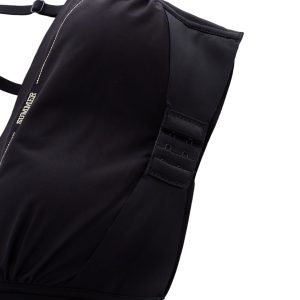
Why Does a Bra Sample Fit Differently After Changing Fabric?
The first bra sample fits well.
The cup looks right.
The underband feels comfortable.
The straps sit correctly.
Then the brand asks to change the fabric.
The pattern remains the same.
The measurements remain the same.
The padding remains the same.
But when the next sample arrives, something feels different.
The band may suddenly feel tighter.
The cup may start gaping.
The neckline may sit differently.
Or the entire bra may feel more restrictive even though the measurement chart has not changed.
This can be confusing during bra sample development, especially for a brand developing its first custom collection.
But there is an important reason:
A bra pattern does not determine fit by itself. The fabric is part of the fit system.
Changing the material can change the behavior of the entire garment.
Same Measurements Do Not Always Mean the Same Fit
Consider two bra samples.
Both have exactly the same underband measurement when placed flat on a table.
Sample A uses a softer, more elastic fabric.
Sample B uses a firmer fabric with stronger recovery.
On the measurement sheet, they may appear identical.
On the body, they can feel completely different.
Why?
Because a bra is worn under tension.
The garment has to stretch around the body, recover toward its original dimensions and work together with elastics, cups, straps and lining.
So a static measurement only tells us part of the story.
For stretch garments, we also need to understand how much force is required to reach that measurement when worn.
Stretch Percentage Is Only the Beginning
When evaluating bra fabric, buyers often ask:
“What is the stretch percentage?”
That is useful information, but it does not fully predict fit.
Imagine two fabrics that can both stretch from 10 cm to 15 cm.
Technically, both may demonstrate similar maximum stretch.
But Fabric A stretches easily with very little resistance.
Fabric B requires considerably more force.
The wearer will not experience those two fabrics in the same way.
This is where fabric recovery and resistance become important.
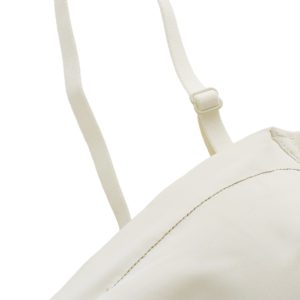
Stretch and Recovery Are Not the Same Thing
Stretch
Stretch describes how far a fabric can extend.
Recovery
Recovery describes how effectively it returns toward its original shape after being stretched.
For bra development, both matter.
A fabric with high stretch but weak recovery may feel comfortable initially but provide insufficient stability.
After repeated wear, it may also lose shape more easily.
A fabric with strong recovery may provide better support but can feel tighter if the pattern was originally developed using a softer material.
This difference is especially noticeable in:
- bra wings;
- sports bras;
- seamless bras;
- fitted underbands;
- compression garments.
So when a customer replaces the original material with another fabric that “looks almost the same,” the actual wearing experience may still change substantially.
The Bra Wing Is Especially Sensitive to Fabric Changes
The wing wraps around the torso and works together with the elastic to stabilize the bra.
Suppose the first sample uses a soft stretch fabric.
After fitting, the customer requests a firmer fabric because it feels more premium.
Visually, the change may be excellent.
But the new material may resist stretching more strongly.
The result?
The customer puts on Sample 2 and says:
“The band is too small.”
The actual flat measurement may still match Sample 1.
The problem may not be the nominal size.
It may be the tension.
At this point, simply making the entire bra larger is not always the best correction.
The development team needs to determine whether the adjustment should be made to:
- wing length;
- elastic tension;
- fabric choice;
- pattern proportions;
- or a combination of these.
A Fabric Change Can Affect the Cup Too
The same principle applies to cups.
Suppose an everyday bra has a foam cup covered by an outer stretch fabric.
The first outer fabric is flexible and easily conforms to the molded cup.
The replacement fabric is thicker and less elastic.
Now the outer layer may pull differently across the cup.
Possible results include:
- neckline tension;
- cup distortion;
- wrinkling;
- flattening of the cup shape;
- pressure around the cup edge.
The foam itself has not changed.
But the material covering it is applying a different force.
That is enough to change the finished result.
Why Can a Cup Start Gaping After a Fabric Change?
This sounds counterintuitive.
If the new fabric is tighter, shouldn’t the cup become tighter too?
Not necessarily.
Bra construction involves several interacting forces.
A change in fabric tension can alter how the cup is positioned relative to:
- the cradle;
- underwire;
- center front;
- straps;
- wing.
If the cup is pulled into a slightly different position, the neckline may no longer sit against the breast in the same way.
That can create gaping even when the cup itself has not become larger.
This is why diagnosing a fit problem based only on the visible symptom can be misleading.
“Cup gaping” does not automatically mean:
Make the cup smaller.
The first question should be:
What changed between the approved sample and this sample?
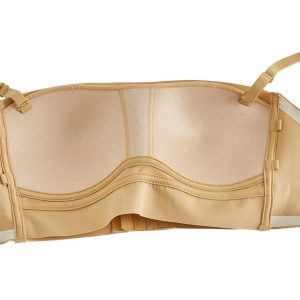
Fabric Weight Can Change the Product Too
Fabric weight is another factor.
A lighter fabric may drape and stretch easily.
A heavier fabric may provide:
- more structure;
- more coverage;
- stronger compression;
- a firmer hand feel.
That may be desirable.
But heavier material can also affect how seams behave and how the bra sits on the body.
For example, changing to a heavier fabric on an everyday wireless bra may improve coverage but reduce the soft, flexible feeling that made the first sample comfortable.
Neither fabric is necessarily “better.”
They simply create different products.
Direction of Stretch Matters
Not every stretch fabric behaves equally in every direction.
Some materials have greater stretch horizontally.
Others provide substantial stretch in both directions.
This matters because different bra panels are designed to control movement in different ways.
For example, a wing usually needs to stretch around the body.
But certain cup areas may need greater stability.
If a replacement fabric has a different stretch direction from the original material, using exactly the same pattern orientation may change the fit.
This is one reason fabric selection and pattern development cannot always be separated.
What Happens When Lining Changes?
Sometimes the customer does not change the visible outer fabric at all.
Instead, the lining changes.
And the fit still changes.
This happens because lining can control the behavior of the outer fabric.
A stable lining can reduce stretch.
A softer stretch lining allows more movement.
Mesh, tricot and other lining materials can therefore influence:
- support;
- breathability;
- compression;
- cup stability;
- wing tension.
This is particularly important when developing larger cup sizes or products requiring more support.
A seemingly small lining substitution can produce a noticeable fit difference.
Elastic Can Be the Hidden Variable
Not every “fabric problem” is actually caused by fabric.
Suppose Sample 2 feels tighter than Sample 1.
The natural conclusion may be:
“The new fabric is too tight.”
But what if the underband elastic also changed?
Different elastics can have different:
- widths;
- thicknesses;
- stretch;
- recovery;
- softness;
- tension.
Even the same elastic can behave differently depending on how much tension is applied during sewing.
So when comparing samples, the development team should check all variables that changed, not just the most obvious one.
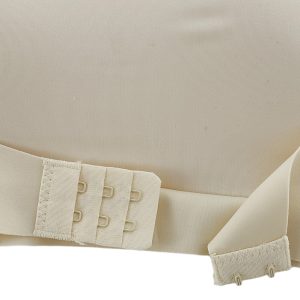
A Simple Example: Everyday Wireless Bra
Imagine a brand developing an everyday wireless bra.
Sample 1
- Soft nylon-spandex outer fabric
- Flexible lining
- Light padding
- Soft underband elastic
The fit is comfortable.
However, the customer wants a smoother, more premium-looking outer fabric.
Sample 2
The new material has:
- slightly higher weight;
- less easy stretch;
- stronger recovery.
Everything else remains unchanged.
The second sample now feels tighter through the body and slightly flatter through the cup.
What should happen next?
There are several possible solutions.
The factory might:
- adjust the wing;
- modify the cup pattern;
- change elastic tension;
- use a different lining;
- reconsider the new outer fabric.
The correct decision depends on which characteristic the brand wants to preserve.
If the new fabric is essential to the collection, the pattern may need to adapt to the fabric.
If the original fit is more important, the brand may decide to return to the first material.
That is product development.
This Is Why “Please Use a Similar Fabric” Can Be Risky
During sourcing, customers sometimes approve a sample and later ask:
“Can you replace this fabric with something similar but cheaper?”
It may be possible.
But “similar” needs to mean more than:
- same color;
- similar appearance;
- same fiber composition.
For a fit-sensitive product like a bra, the replacement should also be evaluated for:
- stretch;
- recovery;
- weight;
- thickness;
- hand feel;
- stability.
Otherwise the brand may save a small amount on material but create a new fit problem.
For bulk production, consistency matters even more.
Should the Pattern or Fabric Be Changed?
There is no universal answer.
The decision depends on which part of the product specification is fixed.
If the Fabric Is Fixed
Perhaps the material is essential to the brand concept.
Then the pattern and construction may need to be adjusted around the fabric.
If the Fit Is Fixed
Perhaps the approved sample already provides exactly the desired fit.
Then it may be better to find a replacement material that behaves more like the original.
If Cost Is Fixed
Sometimes the target price is the main constraint.
Then the development team may need to balance material cost with pattern and construction changes.
This is why good OEM development is often a process of managing trade-offs rather than finding one theoretically “perfect” material.
How Should Brands Compare Two Bra Samples?
When a revised sample fits differently, don’t rely on memory.
Put Sample 1 and Sample 2 side by side.
Then compare systematically.
Check the Materials
Did any of these change?
- outer fabric;
- lining;
- foam;
- mesh;
- elastic;
- straps;
- binding.
Check the Measurements
Compare actual measurements rather than assuming both samples are identical.
Check Stretch and Tension
Stretch the wing and other relevant panels by hand.
Does one require noticeably more force?
Check the Cup
Look at:
- cup height;
- neckline;
- cup volume;
- padding position;
- symmetry.
Check the Bra on the Body
Observe what happens when the wearer:
- raises her arms;
- sits down;
- bends;
- moves;
- wears the bra for an extended period.
The more specific the feedback, the easier it becomes to identify the cause.
Better Sample Feedback Produces Better Revisions
Compare these two comments.
Feedback A
“Sample 2 doesn’t fit. Please make it more comfortable.”
This gives the development team very little information.
Feedback B
“The underband feels approximately 10% tighter than Sample 1 after 30 minutes of wear. The cup shape is acceptable, so we would prefer not to increase cup volume. Please check whether the new wing fabric or elastic tension is causing the additional pressure.”
Now the factory has a clear direction.
Useful sample feedback can include:
- where the pressure occurs;
- whether it happens immediately or after extended wear;
- whether the issue is on both sides;
- whether the garment shifts during movement;
- whether the problem affects one size or the entire size range.
Photos can also help communicate fit issues.
Don’t Approve Fabric and Fit as Two Separate Decisions
One of the most useful lessons in custom bra development is this:
The final fit should be approved using the intended production materials whenever possible.
Approving the fit with Fabric A and then changing to Fabric B immediately before bulk production introduces unnecessary risk.
If a material must change after fit approval, another sample may be worthwhile depending on how significant the change is.
For a simple decorative change, this may not matter.
For a structural fabric, lining, foam or elastic change, it can matter a lot.
Bra Development Is a System, Not a Collection of Independent Parts
A bra is small compared with many garments, but the components interact closely.
Change the fabric and you may change tension.
Change tension and you may change cup position.
Change cup position and you may change neckline fit.
Change the neckline and suddenly the strap position feels different.
This is why solving bra fit problems requires looking at the complete construction rather than adjusting the most visible symptom.
For brands developing original products, understanding these relationships can reduce unnecessary sample revisions and make communication with the manufacturer much more efficient.
Developing a Custom Bra From Your Own Design?
At BrasFactory, our factory in Puning, Guangdong, China works with overseas brands on custom bra and lingerie development.
Customers can provide their own:
- Tech Packs;
- design sketches;
- measurement charts;
- reference samples;
- fabric requirements;
- branding and packaging requirements.
If a sample requires changes, the goal is not simply to “make another sample,” but to identify which material or construction detail is responsible for the difference.
For original customer designs, confidential development information can also be handled under an NDA when required.
BrasFactory
Puning, Guangdong, China
Website: https://www.brasfactory.com/
Email: Climo@brasfactory.com
WhatsApp / WeChat: +86 131 4874 7185
FAQ
Can changing bra fabric affect the fit even if the pattern stays the same?
Yes. Different fabrics have different stretch, recovery, weight and resistance. As a result, two bras made from the same pattern can feel different on the body.
Why does a new bra fabric make the band feel tighter?
The replacement fabric may require more force to stretch or may have stronger recovery. The flat underband measurement can remain similar while the wearing tension increases.
Can changing fabric cause cup gaping?
Yes. Changes in fabric tension can affect how the cup sits relative to the wing, cradle, straps and neckline. Gaping does not always mean the cup itself is too large.
Should I make another sample after changing bra fabric?
If the changed material affects fit or structure—such as outer cup fabric, wing fabric, lining, foam or elastic—another sample can help verify the final fit before bulk production.
What fabric information should I provide for custom bra development?
Useful information includes composition, weight, stretch, recovery, color, hand feel and any specific performance requirements. A physical reference sample can also be helpful.
Can BrasFactory develop bras using customer-supplied fabrics?
Material requirements can be evaluated according to the individual OEM project. Customers can send fabric specifications or reference materials for discussion.