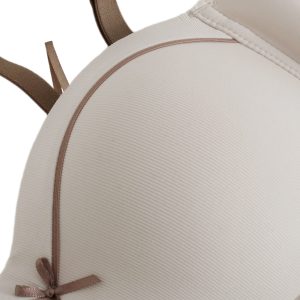
How to Choose the Right Bra Fabric for Your Brand
When developing a bra collection, fabric is often selected first by appearance.
A brand may see a fabric and immediately think:
This looks perfect.
But in bra manufacturing, appearance is only one part of the decision.
Two fabrics may look almost identical in a photo while behaving very differently when they are stretched, sewn and worn.
One may provide firm support.
Another may feel soft but lose recovery after repeated wear.
One may work beautifully for an everyday wireless bra.
Another may be better suited to a structured underwire style.
For brands working with a bra manufacturer, understanding these differences early can help avoid unnecessary sample revisions and create a product that performs the way it was originally intended.
So how should you choose fabric for a custom bra?
Start with the product—not the fabric.
1. First Decide What the Bra Needs to Do
Before asking:
“Which fabric should we use?”
Ask:
“What should this bra feel and perform like?”
For example, these four products have very different requirements:
Everyday wireless bra
Comfort, softness and moderate stretch may be priorities.
Push-up bra
Cup stability, recovery and support become more important.
Sports bra
Compression, moisture management and recovery may matter significantly more.
Lace lingerie bra
Appearance, softness against the skin and compatibility with the underlying construction may take priority.
This is why choosing fabric from a supplier catalog without considering the final product can cause problems.
The fabric specification should support the intended bra.
2. Stretch Percentage Matters—But It Is Not the Whole Story
Stretch is one of the first characteristics manufacturers evaluate.
Suppose two fabrics both contain:
80% Nylon / 20% Spandex
It is easy to assume they will behave similarly.
They may not.
Fiber composition does not tell you everything about:
- stretch direction;
- stretch percentage;
- recovery;
- fabric weight;
- knitting structure;
- surface treatment;
- compression.
One fabric might stretch easily and feel very soft.
Another might require considerably more force to reach the same extension.
That difference can affect how the bra feels around the body.
Why This Matters for the Bra Band
The band is responsible for a significant amount of the bra’s support.
If the wing fabric stretches too easily, the finished band may feel loose even if the pattern dimensions have not changed.
If it is too firm, the same pattern may feel much tighter.
This is one reason changing fabric after fitting can create unexpected results.
We explain this issue further in why bra fit can change after switching fabrics.
3. Recovery Can Be More Important Than Initial Stretch
Imagine pulling two pieces of fabric to the same length.
Both stretch well.
Then you release them.
Fabric A quickly returns close to its original dimensions.
Fabric B remains slightly distorted.
That difference is recovery.
For lingerie, recovery matters because the garment is repeatedly stretched during:
- dressing;
- movement;
- washing;
- wearing;
- removal.
A fabric that stretches comfortably but does not recover sufficiently may eventually make the bra feel less supportive.
This becomes particularly important for:
- bra wings;
- sports bras;
- seamless bras;
- fitted wireless bras;
- high-stretch everyday styles.
For a brand, this means “very stretchy” is not automatically a positive feature.
The real question is:
Does the fabric provide the correct balance between stretch, comfort and recovery for this design?
4. Fabric Weight Changes How a Bra Feels
Fabric weight can influence much more than perceived quality.
A lightweight fabric may create:
- a softer hand feel;
- greater breathability;
- a more delicate appearance.
A heavier fabric may provide:
- greater coverage;
- increased stability;
- stronger compression;
- a more substantial feel.
Neither is automatically better.
It depends on the product.
For example, an ultra-light fabric may work beautifully on a soft bralette but may not provide the performance expected from a high-support sports bra.
Similarly, a heavy compression fabric could technically provide excellent support but feel unnecessarily restrictive in a relaxed everyday bra.
5. Four-Way Stretch Is Not Always Necessary
“Four-way stretch” sounds like an upgrade.
But bra development is not about maximizing every specification.
It is about selecting the appropriate specification.
Some components require controlled stretch.
Others require stability.
A bra may intentionally combine materials with very different properties.
For example:
| Bra Area | Possible Material Requirement |
|---|---|
| Cup | Stable or controlled stretch |
| Wing | Stretch + strong recovery |
| Center front | Greater stability |
| Back | Controlled stretch |
| Lining | Support / stabilization |
| Strap | Limited controlled extension |
This is why a bra should be considered as a system of materials, rather than one fabric used everywhere.
6. The Cup and Wing Do Not Need the Same Fabric
This is especially important for new lingerie brands.
A bra can look visually consistent even when different materials are being used underneath.
For example, lace may cover both the cup and wing.
But internally:
- the cup may have a stable lining;
- the wing may use stretch mesh;
- the center front may be reinforced;
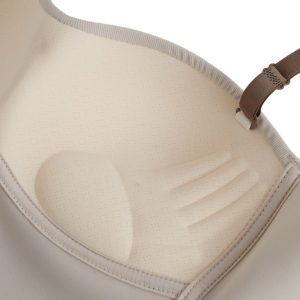
- the cup may contain foam;
- the back may require stronger recovery.
The visible design remains coordinated.
The engineering underneath changes according to function.
This is particularly common in structured bras.
If you are deciding between different cup constructions, see our guide to molded cup vs cut-and-sew bras.
7. What Is Power Mesh—and Why Is It Used in Bras?
Power mesh is commonly used in bra wings and other support areas.
It generally combines stretch with relatively strong recovery.
Its purpose is not simply decoration.
Depending on specification, it can help provide:
- band stability;
- support;
- controlled stretch;
- breathability;
- shape retention.
But power mesh itself comes in different:
- weights;
- densities;
- stretch levels;
- recovery levels;
- hand feels.
So telling a manufacturer:
“Use power mesh.”
is still not a complete specification.
The appropriate version depends on the required support level.
8. What About Lace?
Lace selection creates another set of decisions.
Brands naturally focus on pattern and appearance.
But a manufacturer also needs to consider how the lace behaves.
Stretch Lace
Useful when flexibility and body conformity are required.
Non-Stretch Lace
Can provide greater stability in certain constructions but may require different pattern engineering.
Embroidered Lace
Can create a premium appearance but may involve different cost, cutting and production considerations.
Allover Lace
Often useful when the design requires a continuous lace appearance across larger garment areas.
The scale of the lace pattern matters too.
A beautiful large floral repeat may look excellent on a fabric roll but completely different after being cut into a small bra cup.
That is why evaluating lace at garment scale is important.
9. Soft Fabric Does Not Automatically Mean a Comfortable Bra
This is an important distinction.
A buyer touches an exceptionally soft fabric and thinks:
“This will make the bra comfortable.”
Possibly.
But comfort comes from more than surface softness.
A bra can use very soft fabric and still be uncomfortable because of:
- incorrect band tension;
- unsuitable underwire;
- poor cup fit;
- excessive compression;
- uncomfortable seams;
- incorrect elastic tension;
- strap placement.
Likewise, a slightly firmer fabric may produce a more comfortable finished bra if it provides enough support to keep the garment stable.
So during development, evaluate the complete sample, not only the fabric swatch.
10. Fabric Choice Is Especially Important for Everyday Bras
Everyday bras create an interesting development challenge.
Customers often expect them to be:
soft + supportive + lightweight + smooth + durable
Those requirements can conflict.
Make the fabric extremely soft and light, and you may lose some stability.
Increase compression significantly, and comfort may decrease.
Add heavier lining, and breathability may change.
For an everyday push-up style, the challenge becomes even more complicated because the product also needs to provide lift.
This is why everyday push-up bra padding should be considered together with the cup fabric and construction rather than developed independently.
11. Sports Bra Fabric Requires Different Thinking
Sports bras are another category where fabric performance becomes critical.
The requirements may include:
- compression;
- stretch recovery;
- moisture management;
- abrasion resistance;
- dimensional stability;
- opacity;
- softness.
But even within sports bras, requirements vary.
A low-impact yoga bra does not necessarily require the same fabric as a high-impact running bra.
That means the question should not simply be:
“Do you have sports bra fabric?”
A better brief would be:
“We are developing a medium-support sports bra for gym training. We want a smooth matte fabric with moderate compression and good recovery.”
That gives the manufacturer much more useful sourcing direction.
Brands developing this category can also review our sports bra manufacturing capabilities.
12. Fabric Color Can Affect Development Too
Color sounds like a purely visual decision.
In production, it can become technical.
For example, a bra may contain:
- body fabric;
- lining;
- lace;
- elastic;
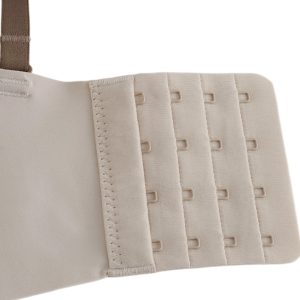
- hook-and-eye;
- straps;
- rings and sliders;
- thread;
- bows.
If the brand requests a specific custom color, multiple components may need to coordinate.
Getting everything to look visually consistent can require:
- lab dips;
- color references;
- dyeing;
- component matching;
- approval rounds.
This is why brands planning custom colors should communicate them early.
Waiting until the final sample to decide on a completely new color direction can add unnecessary development time.
13. Should You Choose Fabric Before Sending the Tech Pack?
Not necessarily.
A Tech Pack can specify either:
an exact material
or
a required material performance.
For example:
Instead of:
Fabric: Nylon/Spandex
a more useful specification might say:
Soft stretch microfiber suitable for an everyday bra wing, matte surface, medium weight, good recovery.
The manufacturer can then source options that fit the intended result.
If you already know the exact fabric code, that can of course be included as well.
For more on preparing development information, see our bra Tech Pack guide.
14. Ask for Fabric Swatches Before Making a Final Decision
Photos can help narrow down options.
They cannot tell you how a fabric feels.
Before approving an important material, a physical swatch can help you evaluate:
- softness;
- thickness;
- stretch;
- surface appearance;
- transparency;
- color;
- texture.
For larger development projects, brands may compare several similar fabrics before selecting one for sampling.
You can label them:
Option A
Option B
Option C
Then keep the selected code documented throughout development.
This reduces confusion later.
15. Do Not Choose Fabric Based Only on Price
Suppose Fabric A costs slightly less than Fabric B.
Choosing A appears to reduce the unit cost.
But what if Fabric A:
- does not recover well;
- creates fitting problems;
- requires additional lining;
- produces more defects;
- does not create the desired appearance?
The cheaper raw material does not necessarily create the cheaper finished product.
Material selection should therefore consider both:
cost
and
product performance.
If you are trying to understand what affects the final factory price, see our bra manufacturing cost guide.
A Simple Fabric Brief You Can Send to a Bra Manufacturer
If you do not know technical fabric terminology, that is okay.
You can start with something like this:
Product: Everyday wireless bra
Customer: Women’s everyday comfort market
Feel: Soft and smooth
Surface: Matte
Stretch: Medium
Support: Medium
Thickness: Lightweight to medium
Recovery: Good
Color: Black / Nude / White
Special Requirement: Fabric should not feel highly compressive
Reference: Similar hand feel to attached sample
This gives the factory enough direction to begin recommending materials.
Compare that with:
“Please find us a good fabric.”
The first brief is much more likely to produce relevant options.
What Should You Ask Your Manufacturer About a Fabric?
Before final approval, consider asking:
- Is this fabric suitable for the intended bra construction?
- How does its stretch compare with the sample fabric?
- Does it have good recovery?
- Is it available consistently for bulk production?
- Is there a minimum quantity for custom dyeing?
- Can the color be matched across the other components?
- Does changing to this fabric require another fit sample?
You may not need to ask every question for every material.
But for a custom OEM collection, these questions can prevent expensive assumptions.
Fabric Selection Should Happen Together With Product Development
A common mistake is treating fabric sourcing and bra development as two independent tasks.
They are connected.
A change in fabric can affect:
Fabric
↓
Stretch & recovery
↓
Garment tension
↓
Fit
↓
Support
↓
Customer experience
This is why experienced bra development requires more than finding something that looks similar to the designer’s reference image.
The material needs to work with the pattern and construction.
Develop Your Bra Collection With BrasFactory
BrasFactory provides OEM and private label bra development for overseas lingerie brands from our factory in Puning, Guangdong, China.
Customers may come to us with:
- Tech Packs;
- original designs;
- reference garments;
- sketches;
- material references;
- measurement charts;
- existing samples.
Depending on the project, we can evaluate material options together with the intended construction, fit and production requirements.
If you are planning your own collection, explore our private label lingerie manufacturing services.
You can also read our guide on how to choose a bra manufacturer in China when evaluating production partners.
For a new OEM project, contact BrasFactory with your design, Tech Pack or reference product.
BrasFactory
Puning, Guangdong, China
Website: https://www.brasfactory.com/
Email: Climo@brasfactory.com
WhatsApp / WeChat: +86 131 4874 7185
FAQ
What fabric is best for bras?
There is no single best bra fabric. The appropriate material depends on the bra construction, required support, stretch, recovery, comfort, appearance and target price.
What fabric is commonly used for bra wings?
Stretch fabrics and power mesh are commonly used depending on the required support and construction. The exact stretch and recovery should be selected according to the design.
Is nylon spandex good for bras?
Nylon-spandex fabrics are widely used in lingerie, but fiber composition alone does not determine whether a particular fabric is suitable. Weight, stretch, recovery and knitting structure also matter.
Can I change the fabric after approving my bra sample?
You can, but a major fabric change may affect fit and support. If the replacement material behaves differently, another sample evaluation may be necessary.
Can a bra manufacturer help source fabric?
For OEM projects, manufacturers can often source material options based on the customer’s design and performance requirements. Providing a clear material brief helps narrow down suitable choices.
Should I send a physical fabric reference to the factory?
If matching a particular hand feel, stretch or appearance is important, a physical reference can be very useful because these characteristics are difficult to communicate accurately through photographs alone.